by Federica Latora 3A
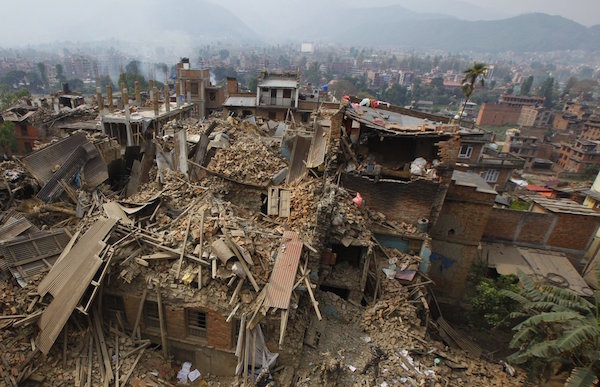
In April 2015 an earthquake killed more than 8,000 people and injured more than 19,000. It occurred at 11:56 a.m. on 25th April, with a magnitude of a maximum Mercalli Intensity of IX (violent). Its epicenter was the village of Barpak, Gorkha district, and its hypocenter was at a depth of approximately 15 Km. It has been the worst natural disaster to strike Nepal since 1934. Hundreds of thousands of people were made homeless with entire villages flattened to ground level. Geophysicists and other experts had warned for decades that Nepal was vulnerable to a deadly earthquake, particularly because of its geology, urbanization and architecture. A second major earthquake occurred on 12 May at 12:35 a.m. The epicenter was near the Chinese border. More than 65 people were killed and over 1,200 were injured by this aftershock.
The causes of the catastrophic earthquakes in Nepal are rooted in the same geological phenomenon that draws nearly a million tourists to the remote region every year: the crash of continental plates that produced the highest mountains in the world. Hundreds of millions years ago, what is now the Indian subcontinent broke off from an ancient supercontinent called Gondwanaland and began its inexorable drift northward, smashing into the Eurasian tectonic plate ten millions of years ago and giving rise to the Himalayan mountain range. That collision continues today, with the Indian plate sliding beneath the Eurasian plate at the rate of about 2 inches (40 to 50 millimeters) per year. This is a very complex region where plates push against each other, and gravitational forces on the mountains push down.
As economic effect, people affected by the earthquake will have only a short time to plant crops before the onset of the Monsoon rains. Rebuilding the economy will need international effort over the next few years. UNICEF has appealed for donations, since close to 1.7 million children have been driven out into the open, and are in desperate need of drinking safe water, getting medical attention as well as psychological counsel, and, in general, protection from expected disease outbreak.