by Alberta Carella, 4A — pictures by Luna Parisi 4A and Giacomo Gori 4E
On Thursday, 10th April 2014 we went to Trieste to see two Orthodox churches. In particular we visited the Greek-Orthodox church of St. Nicholas (San Nicolò) and the Serbian-Orthodox church of St. Spiridion (San Spiridione) .
St. Nicolò’s was built between 1784 and 1787 and, after several restorations, was completed between 1819 and 1821 by the architect Matteo Persch, one of the leading exponents of Italian Neoclassicism. Outside there are two bell-towers, expression of Neoclassicism in Trieste.
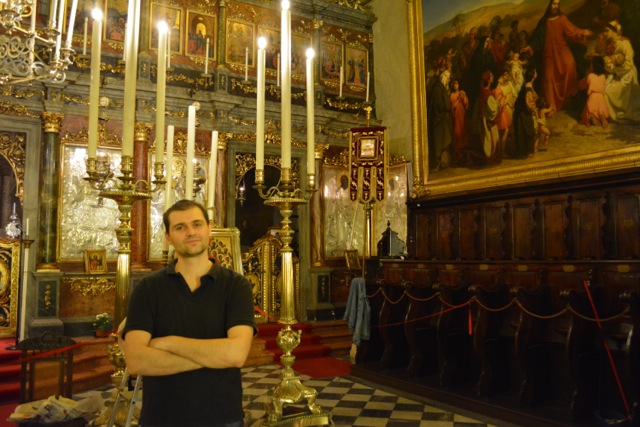
This church is divided into four liturgical spaces: the single nave, the presbytery, two balconies and the iconostasis. In the nave, paved with white and black marble panels, there are three candlesticks and the icon of St. Nicholas. The ceiling is covered with a painting depicting Christ surrounded by angels. On the side walls there are two large tables: the former shows the Preaching of St. John the Baptist, while the latter shows Christ in the act of blessing the children.
An iconostasis, which divides the presbytery from the choir, is made of a wooden wall with three doors with gilded carvings and paintings.
Above the doors there are pictures depicting St. Peter, St. Paul and other Fathers of the Church. On the top there are twenty-one paintings representing Gospel scenes. In the lower part there are eight icons with silver covers.
The two balconies – one formerly reserved to the matroneum, and the other used by the choir- are decorated with biblical scenes.
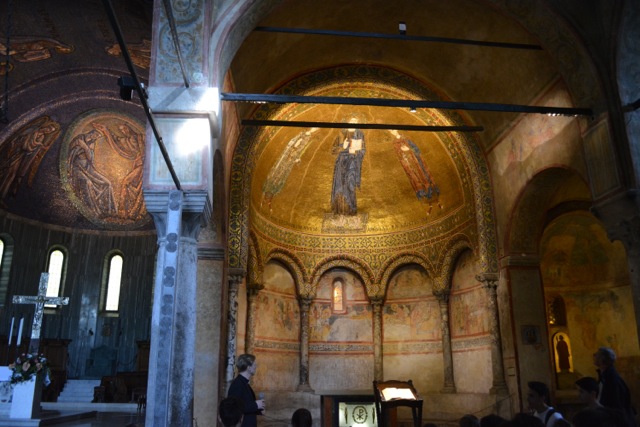
We also visited St. Spiridion’s, a church that was built between 1861 and 1868. It has a Greek cross plan surmounted by five domes with hemispherical blue caps.
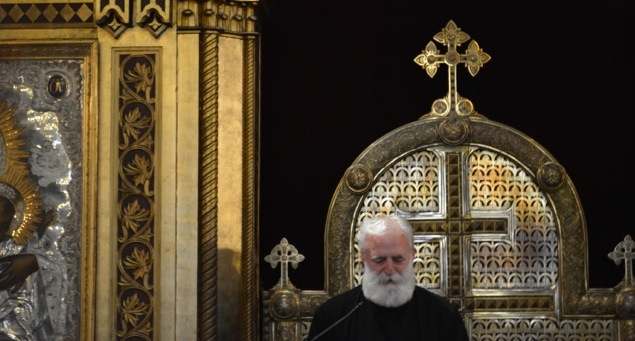
The inside the church is decorated according to the canons of Byzantine art with paintings and mosaics. There are four gold and silver icons depicting the Virgin Mary, Jesus, St. Spiridion and the Annunciation. The large silver candelabrum is particularly interesting. It was donated by Tsar Paul I.
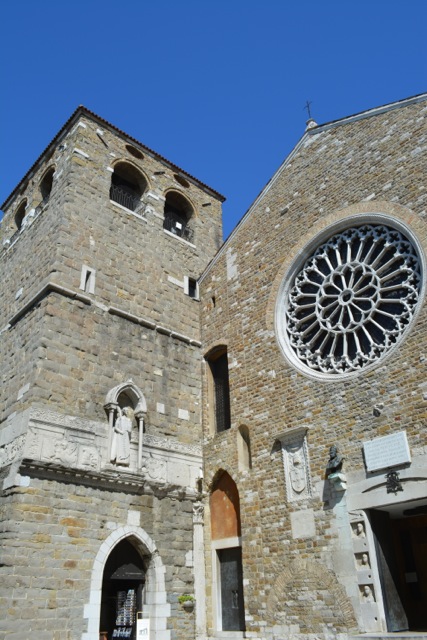
In the afternoon we visited St. Justus’s Cathedral (San Giusto), the most important Catholic building of Trieste.
The facade of the church is decorated with a huge rose window and on the bell tower there is a statue of St. Justus holding a palm. Inside, on the floor, there are mosaics dating from the fifth century, while the apses are decorated with Byzantine mosaics.
Inside the church there are also sacred artefacts, for example St. Sergius’s halberd, the second patron saint of the city. In the side chapel there are the original frescoes representing St. Justus’s life. The martyr was denounced for blasphemy and sentenced to death by drowning. The waters of the Gulf of Trieste were the place of martyrdom.
We also visited the ruins of the Roman forum, near the church.
I enjoyed the visit to St. Nicholas’ better because it was amazing inside and it was explained by our guide Giovanni – the church sacristan – very well. The school outing was very interesting because we saw a beautiful city and we learnt more about Orthodox Christianity with Mrs Giovanna Lindaver, our Religion teacher.
[important]
EASTERN ORTHODOX CHURCH
The Eastern Orthodox Church originated in the Greek-speaking Church of the Byzantine Empire, not accepting the authority of the Pope of Rome and using elaborate and archaic forms of service.
The chief Orthodox Churches include the national Churches of Greece, Russia, Bulgaria, Romania and Serbia. The term is also used by the Coptic, Syrian and Ethiopian Churches.
At the moment the fastest growing Orthodox Church in Trieste is the Romanian community, but they have not built their church so far.
[/important]